WELDING
Instructor: Mr. Jamie Walden
Visit the Teacher WebsiteCut. Join. Create.
Want to turn raw metal into something built to last? Welding gets you out of a traditional classroom and into the shop, where precision, problem-solving, and quality workmanship come together through real projects. Whether you already have experience working with metal or are ready to learn from the beginning, this program gives you a place to develop your abilities and start building your future.
Welding is a two-year program with 18 total spots available each year across Berea, Carolina, Travelers Rest, and Wade Hampton High Schools. Choosing the program means planning to complete both years and make the most of this limited opportunity.
What Students Learn
Students develop practical welding and fabrication skills they can use to complete metal projects while building the technical foundation needed for future education and careers in construction, manufacturing, maintenance, and the skilled trades.
- Work safely: Recognize welding hazards, use personal protective equipment, and follow safe procedures for tools, equipment, gases, electricity, and material handling.
- Cut and prepare metal: Use oxyfuel and plasma equipment, grinders, and measuring tools to cut, clean, bevel, fit, and align materials.
- Read welding information: Interpret dimensions, views, notes, welding symbols, detail drawings, and welding procedure specifications.
- Perform welding processes: Set up equipment and complete welds using SMAW, GMAW, FCAW, and GTAW.
- Inspect completed work: Identify weld imperfections, evaluate quality, solve problems, and complete fabrication projects to established specifications.
Is This Program Right for You?
Students should be ready to:
- Commit to completing both years
- Attend regularly and arrive prepared
- Follow all lab safety procedures
- Work carefully and stay organized
- Practice skills repeatedly and accept feedback
- Take increasing responsibility for their work
These habits help students succeed in the lab, advance to Year Two, earn certifications, and compete for Work-Based Learning opportunities.
Your Two-Year Welding Pathway
Each semester of your two-year commitment builds on the one before it, allowing students to develop stronger technical skills, greater independence, and professional workplace habits.
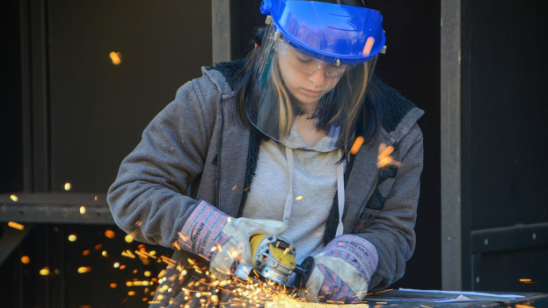
Semester 1 | Building the Foundation
Year One begins the two-year commitment and helps students turn an interest in welding and metalwork into real technical skills through classroom instruction, hands-on lab experiences, and real-world training. The morning program is open to rising 10th- and 11th-grade students who are prepared to complete both years.
Students focus on:
- Recognizing welding hazards and using required personal protective equipment
- Identifying common welding, cutting, measuring, and material-handling tools
- Setting up and operating oxyfuel and plasma arc cutting equipment
- Cleaning, cutting, beveling, and preparing base metal
- Identifying basic joint designs and preparing materials for fit-up
Semester 2 | Developing Welding Control
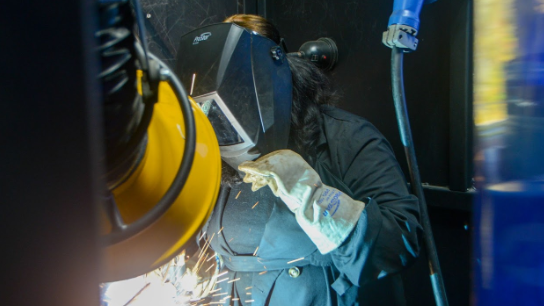
Students take on more challenging work as they set up shielded metal arc welding equipment, select electrodes, and develop control through beads, fillet welds, and groove welds in multiple positions. To advance to Year Two, students must demonstrate mastery of required skills and earn a grade of 75 or higher each quarter.
Students focus on:
- Setting up SMAW equipment and selecting the correct electrodes
- Striking and maintaining an arc while controlling angle, speed, and travel
- Creating stringer, weave, and overlapping beads
- Completing fillet welds in horizontal, vertical, and overhead positions
- Performing groove welds with backing while controlling fit-up and distortion
Semester 3 | Advancing Technical Skills
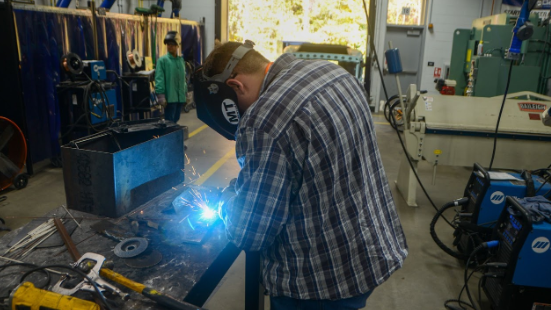
After completing Welding 1 and 2, students return for the afternoon session and the second year of their two-year commitment. They build on their Year One skills, interpret technical information, complete more advanced plate welding, and may become eligible for Work-Based Learning or co-op opportunities.
Students focus on:
- Reading welding symbols, dimensions, views, notes, and detail drawings
- Using drawings and specifications to plan fit-up and fabrication work
- Identifying metal properties and applying preheating and post-heating procedures
- Setting up GMAW and FCAW equipment, gases, transfer modes, and filler metals
- Completing multiple-pass fillet and open-root groove welds on plate
Semester 4 | Preparing for the Industry
Students complete the two-year program through advanced welding, fabrication, and quality-control projects. They work with greater independence while preparing for technical college, apprenticeships, industry certification, entry-level employment, and other opportunities in the welding industry.
Students focus on:
- Identifying weld imperfections and applying quality-control and testing methods
- Completing open-root SMAW plate welds in multiple positions
- Performing advanced pipe fit-up and open-root pipe welding techniques
- Setting up GTAW equipment and welding carbon steel, aluminum, or stainless materials
- Planning, completing, inspecting, and documenting advanced work with greater independence
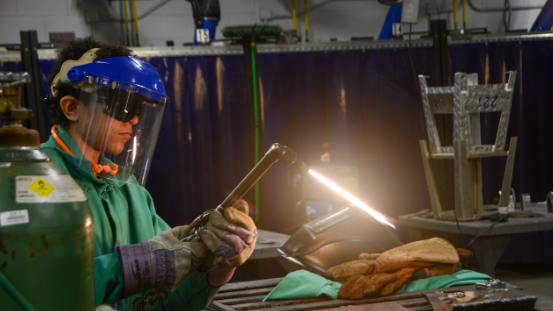
Work-Based Learning
Eligible Year Two students may be recommended for Work-Based Learning or co-op opportunities with local construction, manufacturing, fabrication, and industrial employers. These earned experiences allow students to apply their skills with an employer, gain on-the-job experience, and potentially earn while they learn.
Placement is not guaranteed. Students must meet school eligibility requirements, and each sponsoring company may establish additional expectations related to age, experience, certifications, attendance, and workplace readiness.
Industry Certifications
Students may pursue industry-recognized certifications as they progress through the program:
- Tier 1: OSHA 10-Hour, NCCER Core, and Snap-on/NC3 Precision Measurement
- Tier 2: Welding Technology and Snap-on/NC3 Multimeter 504
- Tier 3: American Welding Society certifications in structural welding, pipe welding, or advanced processes, depending on student progression and available testing opportunities
Career Opportunities
Welding can lead to careers involving fabrication, construction, manufacturing, pipe systems, industrial maintenance, inspection, and technical leadership.
Welder
Fabricator
Welder fabricators read drawings, measure and cut materials, prepare joints, and join metal components to build or repair products and structures. They use welding and fabrication equipment while checking completed work for alignment, strength, appearance, and accuracy.
Pipe
Welder
Pipe welders prepare, align, join, and repair piping systems used in construction, manufacturing, energy, and industrial settings. Their work requires strong positional welding skills and careful attention to procedures, safety requirements, and quality standards.
Industrial
Maintenance Welder
Industrial maintenance welders repair equipment, machinery, and metal systems so facilities can operate safely and efficiently. They diagnose damage, select appropriate materials and processes, complete repairs, and verify that equipment is ready to return to service.
Certified Welding
Inspector
Certified Welding Inspectors evaluate materials, procedures, workmanship, and completed welds for compliance with codes and specifications. This advanced career requires strong technical knowledge, professional experience, careful documentation, and additional industry certification.
Visit the Program
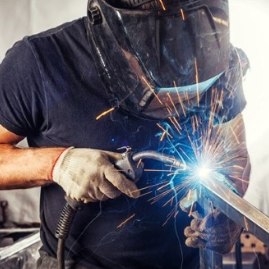
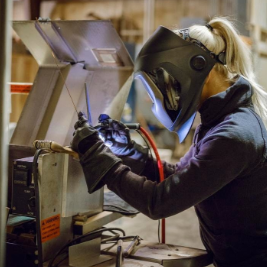
Students can explore the Welding lab and meet Mr. Walden during scheduled school tours. Students and parents are also invited to visit the classroom during Enoree's Fall Recruiting Open House and Lab-or-Treat in late October or our Spring Recruiting Open House in March. Visit the front page of our website or follow us on social media for event details as they become available.
A visit provides a closer look at the hands-on training, tools, equipment, projects, and opportunities available throughout the two-year program. It also gives families an opportunity to ask questions and consider the student's interest, schedule, transportation, attendance, safety awareness, and readiness to complete both years.
Local Work-Based Learning Partners
Local employers help eligible Year Two students connect classroom and lab instruction with professional welding and fabrication experiences. Students may be recommended for Work-Based Learning or co-op after demonstrating the technical skill, maturity, dependability, and academic standing needed to represent themselves, Enoree Career Center, and the sponsoring employer well.

Two-year commitment note: This program is designed as one connected two-year experience. Year One develops the foundational skills students need for the advanced training, certifications, independence, and potential Work-Based Learning opportunities available during Year Two. New students enter only at the beginning of Year One and cannot join the program during Year Two. Because enrollment is limited, every accepted student fills a spot that cannot be offered to another interested student. If that student does not return for Year Two, the spot remains vacant and the opportunity is lost for both the student and someone who was prepared to complete the full program. Students who accept a spot should plan to complete both years, make the most of the opportunity, and follow through on their commitment.
Work-Based Learning note: Work-Based Learning is a culminating goal of each program, giving eligible students the opportunity to apply their technical skills in a real workplace. Placement is not guaranteed and must be earned by meeting program, school, and employer expectations. When available, Work-Based Learning may include paid on-the-job training and may lead to employment, tuition assistance, industry certifications, or continued education opportunities.
Graduation and college admission note: Students earn four high school credits each year and may earn up to eight credits by completing the full two-year program. These credits count toward South Carolina high school graduation requirements as applicable, and one credit may fulfill the state’s World Language or Career and Technology Elective requirement. Career center coursework generally does not replace the world-language coursework required for admission to four-year colleges and universities. Because graduation and college admission requirements may vary, students and families should work with both their home high school counselor and the Enoree Career Center counselor to ensure the student’s career center program, graduation plan, and future education goals remain aligned.