CULINARY ARTS
Dual Enrollment with Greenville Technical College
Instructor: Chef Bill Twaler
Visit the Teacher WebsitePrepare. Create. Serve.
Want to turn your interest in food into an experience that goes far beyond following a recipe? Culinary Arts puts you in a professional kitchen, where you will work as part of a team, create food for others, and experience the pace and expectations of the culinary industry. Whether you already enjoy cooking or are ready to learn from the beginning, this program gives you a place to start building your future.
Culinary Arts is a two-year program with 20 total spots available each year across Berea, Carolina, Travelers Rest, and Wade Hampton High Schools. Choosing the program means planning to complete both years and make the most of this limited opportunity.
What Students Learn
Students develop practical culinary skills they can use in the kitchen today while building the technical foundation needed for future education and careers in culinary arts and hospitality.
- Prepare food safely: Prevent cross-contamination, control temperatures, sanitize work areas, and follow professional food-handling procedures.
- Use culinary tools and equipment: Practice knife skills and safely operate equipment found in professional kitchens.
- Apply cooking and baking techniques: Follow recipes and use proper methods to prepare a variety of foods and baked products.
- Plan and present menus: Consider flavor, nutrition, cost, portion size, culture, dietary needs, plating, and customer expectations.
- Operate a food-service kitchen: Coordinate production, service, purchasing, inventory, sanitation, and team responsibilities.
Is This Program Right for You?
Students should be ready to:
- Commit to completing both years of the program
- Attend regularly and arrive prepared to work
- Follow all kitchen safety and sanitation procedures
- Work on their feet in a fast-paced environment
- Communicate, cooperate, and accept feedback
- Take increasing responsibility as skills grow
These habits help students succeed in the kitchen, advance to Year Two, earn certifications and college credit, and compete for Work-Based Learning opportunities.
Your Two-Year Culinary Arts Pathway
Each semester of the two-year commitment builds on the one before it, allowing students to develop stronger culinary skills, greater independence, and professional food-service habits.
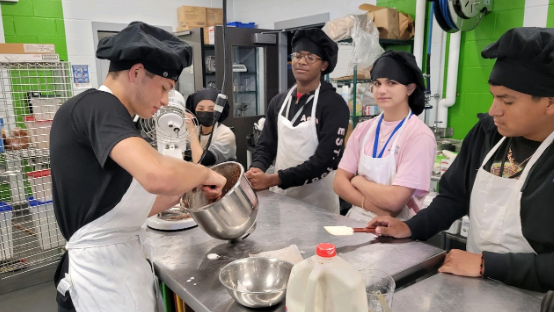
Semester 1 | Building the Foundation
Year One begins the two-year commitment with the first half of Culinary Arts 1. Students develop the safety, sanitation, professionalism, service, and foundational food-production skills required in a food-service kitchen. During this semester, students also complete CUL 155 Sanitation through Greenville Technical College and earn college credit upon successful completion.
Students focus on:
- Food safety, sanitation, HACCP, and food-service regulations
- Professional appearance, workplace habits, careers, and resumes
- Dining service styles and front- and back-of-house responsibilities
- Safe selection and use of knives, tools, and equipment
- Mise en place and fundamental cooking and preparation techniques
Semester 2 | Developing Culinary Skills
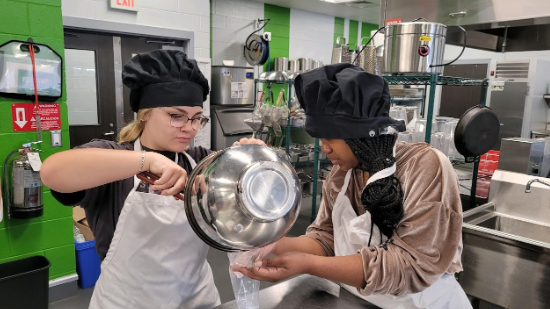
Students complete Culinary Arts 1 by applying their kitchen foundation to recipes, menus, cuisines, culinary math, nutrition, management, and sustainability. They plan and prepare food with greater independence while considering customer needs and the business side of food service. To advance to Year Two, students must demonstrate mastery of required skills and earn a grade of 75 or higher each quarter.
Students focus on:
- Recipes, menus, flavor profiles, and regional and global cuisines
- Measurements, conversions, yields, food costs, and portion control
- Nutrition, cultural dietary needs, and recipe modifications
- Food-service management, marketing, and business planning
- Sustainable kitchen practices and food-service sustainability plans
Semester 3 | Advancing Culinary Skills
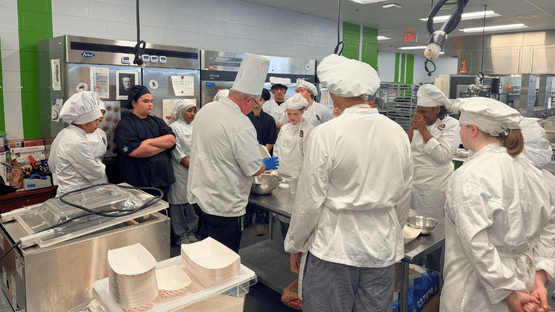
After completing both semesters of Culinary Arts 1, students return for the second year of their two-year commitment and begin Culinary Arts 2. They apply advanced sanitation, professionalism, service, and production standards while coordinating more complex kitchen work and preparing for possible Work-Based Learning or co-op opportunities.
Students focus on:
- Advanced sanitation, kitchen audits, safety laws, and risk reduction
- Professional communication, ethics, uniforms, and certifications
- Employability, interviews, career planning, and entrepreneurship
- Service stations, workflow, teamwork, and quality standards
- Advanced food production, mise en place, plating, and garnishing
Semester 4 | Preparing for the Industry
Students complete Culinary Arts 2 and the two-year program by applying advanced menu development, culinary math, nutrition, management, and sustainability standards. They work with greater independence while preparing for culinary school, hospitality programs, apprenticeships, employment, and entrepreneurship.
Students focus on:
- Menu engineering, themes, trends, marketability, and legal considerations
- Cost analysis, pricing, purchasing, yields, and profitability
- Nutrition planning and recipe modifications for different populations
- Supervision, financial responsibility, marketing, and customer satisfaction
- Food-supply issues, farm-to-table practices, and sustainable operations
Work-Based Learning
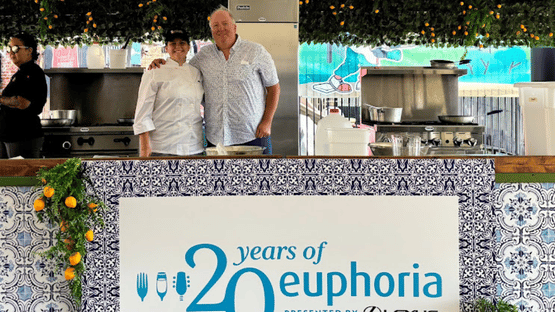
Eligible Year Two students may be recommended for Work-Based Learning or co-op opportunities with local restaurants and hospitality employers. These earned experiences allow students to apply their skills with an employer, gain on-the-job experience, and potentially earn while they learn.
Placement is not guaranteed. Students must meet school eligibility requirements, and each sponsoring employer may establish additional expectations related to age, experience, certifications, attendance, and workplace readiness.
Industry Certifications
Students may pursue industry-recognized certifications as they progress through the program:
- Tier 1: OSHA 10-Hour and ServSafe Food Handler
- Tier 2: YouScience Event Planning and Management, Hospitality and Tourism, and Lodging and Recreation
- Tier 3: ServSafe Food Manager and ProStart credentials, including START Restaurant Server, Breakfast Attendant, and Kitchen Cook
Dual Enrollment and College Credit
Culinary Arts is offered in partnership with Greenville Technical College. During the first semester, students complete CUL 155 Sanitation as a dual enrollment course and earn Greenville Technical College credit upon successful completion.
Students must complete the college enrollment process and meet applicable Greenville Technical College and dual enrollment requirements. Families should speak with their school counselor and Chef Twaler about enrollment, college-credit records, and how the course may apply to future education.
Career Opportunities
Culinary Arts can lead to careers in restaurants, bakeries, hotels, catering, food service, hospitality management, and entrepreneurship.
Restaurant
Cook
Restaurant cooks prepare ingredients and menu items at assigned kitchen stations. They follow recipes, maintain sanitation standards, coordinate timing with the team, and help serve food safely and consistently.
Baker or
Pastry Cook
Bakers and pastry cooks prepare breads, pastries, cakes, desserts, and other baked products. They follow formulas, manage ingredients, organize production, and create items with consistent flavor and presentation.
Sous
Chef
Sous chefs support kitchen leadership, food production, staff coordination, quality control, sanitation, and inventory. They help organize daily operations and often serve as second-in-command in a professional kitchen.
Executive
Chef
Executive chefs oversee menus, food quality, staffing, purchasing, cost control, sanitation, and kitchen operations. This leadership role combines advanced culinary skill with significant professional experience and management ability.


Visit the Program
Students can explore the Culinary Arts kitchen and meet Chef Twaler during scheduled school tours. Students and parents are also invited to visit the classroom during Enoree’s Fall Recruiting Open House and Lab-or-Treat in late October or our Spring Recruiting Open House in March. Visit the front page of our website or follow us on social media for event details as they become available.
A visit provides a closer look at the hands-on training, tools, kitchen equipment, food-service projects, and opportunities available throughout the two-year program. It also gives families an opportunity to ask questions and consider the student’s interest, schedule, transportation, attendance, dual enrollment responsibilities, and readiness to complete both years.
Local Work-Based Learning Partners
Local restaurants and hospitality employers help eligible Year Two students connect classroom and kitchen instruction with professional culinary workplace experiences. Students may be recommended for Work-Based Learning or co-op after demonstrating the technical skill, maturity, dependability, and academic standing needed to represent themselves, Enoree Career Center, and the sponsoring employer well.
Two-year commitment note: This program is designed as one connected two-year experience. Year One develops the foundational skills students need for the advanced training, certifications, independence, and potential Work-Based Learning opportunities available during Year Two. New students enter only at the beginning of Year One and cannot join the program during Year Two. Because enrollment is limited, every accepted student fills a spot that cannot be offered to another interested student. If that student does not return for Year Two, the spot remains vacant and the opportunity is lost for both the student and someone who was prepared to complete the full program. Students who accept a spot should plan to complete both years, make the most of the opportunity, and follow through on their commitment.
Work-Based Learning note: Work-Based Learning is a culminating goal of each program, giving eligible students the opportunity to apply their technical skills in a real workplace. Placement is not guaranteed and must be earned by meeting program, school, and employer expectations. When available, Work-Based Learning may include paid on-the-job training and may lead to employment, tuition assistance, industry certifications, or continued education opportunities.
Dual enrollment note: This program includes coursework offered for dual enrollment through Greenville Technical College, allowing eligible students to earn both high school and college credit upon successful completion. Students must complete all required enrollment steps and meet applicable high school, college, and dual enrollment requirements to participate and receive credit.
Graduation and college admission note: Students earn four high school credits each year and may earn up to eight credits by completing the full two-year program. These credits count toward South Carolina high school graduation requirements as applicable, and one credit may fulfill the state’s World Language or Career and Technology Elective requirement. Career center coursework generally does not replace the world-language coursework required for admission to four-year colleges and universities. Because graduation and college admission requirements may vary, students and families should work with both their home high school counselor and the Enoree Career Center counselor to ensure the student’s career center program, graduation plan, and future education goals remain aligned.