EMERGENCY MEDICAL SERVICES
Tentatively Planned for the 2027–2028 School Year
This program remains in the planning and approval process. Course availability, eligibility requirements, certifications, scheduling, and other program details are subject to change.
Assess. Respond. Care.
Could you stay calm, think clearly, and provide care when someone needs help most? Emergency Medical Services training places students in realistic medical and trauma scenarios where communication, sound judgment, teamwork, and attention to detail matter.
Enoree Career Center is working toward the possible addition of a one-year Emergency Medical Services program for the 2027–2028 school year. If approved, students would complete EMS 1 and EMS 2 through classroom instruction, hands-on skills practice, and scenario-based learning.
What Students Learn
Students develop practical emergency-care skills while building the medical knowledge, professionalism, and sound judgment needed for continued education and entry-level opportunities in emergency medical services.
- Assess patients: Gather information, take vital signs, complete primary and secondary assessments, and recognize medical and trauma emergencies.
- Manage breathing emergencies: Position airways, provide oxygen and ventilation support, and perform CPR and AED procedures.
- Provide emergency care: Control bleeding, manage shock, stabilize injuries, assist with approved medications, and care for patients of different ages.
- Move patients safely: Apply body mechanics, lifting, carrying, packaging, spinal-motion restriction, and ambulance-transport principles.
- Operate professionally: Communicate with patients and responders, document care, follow medical direction, protect privacy, and work within the EMS system.
Is This Program Right for You?
Students should be ready to:
- Commit to completing the full school-year sequence
- Complete rigorous medical coursework and skills practice
- Communicate maturely during realistic emergency scenarios
- Meet attendance, health, safety, and course requirements
- Work calmly, carefully, and respectfully with patients and teammates
- Accept feedback and demonstrate required skills consistently
These habits help students progress through the course sequence, demonstrate required skills, prepare for available certification testing, and provide safe and compassionate patient care.
Tentative Program Status
Emergency Medical Services is not currently an active Enoree program. Enoree hopes to offer the program beginning with the 2027–2028 school year, but final approval depends on staffing, facilities, scheduling, regulatory requirements, student demand, and other program-development needs.
Your Proposed One-Year EMS Pathway
The proposed two-credit sequence would connect EMS 1 and EMS 2 during one school year, allowing students to progress from foundational emergency care to Emergency Medical Responder preparation.
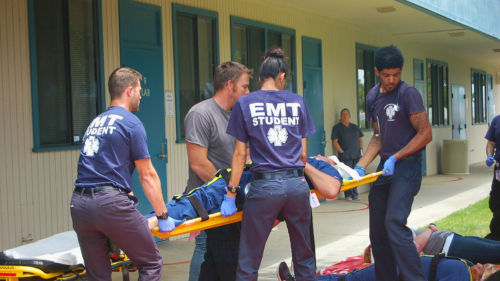
Semester 1 | Building the EMS Foundation
Students would complete EMS 1 as they learn to recognize emergencies, provide immediate care, and support patients until more advanced medical personnel arrive. The semester would combine medical knowledge, professional expectations, and supervised skills practice.
Students focus on:
- EMS systems, provider roles, medical direction, safety, and professionalism
- Medical terminology, anatomy, physiology, and mechanisms of illness and injury
- Patient assessment, vital signs, communication, and documentation
- Airway care, CPR, AED use, bleeding control, shock, and trauma care
- Emergency Medical Responder skills for medical, trauma, and special-population emergencies
Semester 2 | Emergency Medical Responder Skills
Students who successfully complete EMS 1 would continue into EMS 2, where they build the knowledge and practical skills needed to provide immediate care until more advanced medical personnel arrive. Students would practice patient assessment, emergency care, communication, and safe response procedures through classroom instruction and realistic scenarios.
Students focus on:
- Primary and secondary patient assessment, vital signs, and ongoing reassessment
- Airway, respiratory, cardiac, medical, trauma, and resuscitation emergencies
- Care for pediatric, geriatric, obstetric, behavioral, and other special populations
- Bleeding control, shock management, splinting, patient movement, and stabilization
- Emergency Medical Responder skills, teamwork, communication, and certification preparation
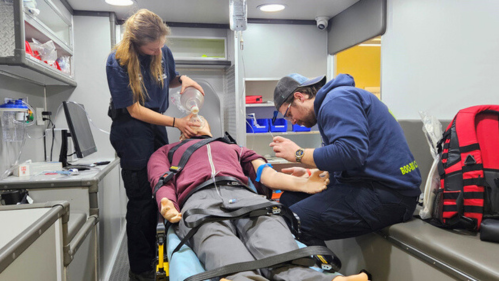
Eligibility and Course Requirements
Final admission requirements will be confirmed before applications begin. Based on the current EMS 1 and EMS 2 standards, students should expect requirements that include:
- Enrollment as an eligible 10th-, 11th-, or 12th-grade student
- Successful completion of EMS 1 with a grade of 75 or higher before advancing to EMS 2
- Meeting applicable health, safety, attendance, skills, and course requirements
Industry Certifications
If approved, students may pursue credentials aligned with the course sequence and applicable state requirements:
- Foundational credentials: First Aid, CPR and AED, Stop the Bleed, and Basic Life Support for Healthcare Providers
- Emergency-response credentials: Emergency Medical Responder and approved FEMA incident-command credentials
Career Opportunities
Emergency medical training can provide a foundation for careers in EMS, fire and rescue, healthcare, public safety, and emergency management. Advanced careers require additional education, experience, certification, or professional licensure.
Emergency Medical
Technician
EMTs assess patients, provide basic emergency treatment, stabilize injuries, document care, and transport patients safely to medical facilities.
Advanced EMT or
Paramedic
Advanced EMTs and paramedics provide higher levels of emergency care. These careers require additional education, supervised training, testing, and certification.
Firefighter-
EMT
Firefighter-EMTs combine fire-response training with emergency medical care. Fire departments establish additional physical, training, testing, and certification requirements.
Healthcare
Professional
EMS experience can support continued education in nursing, respiratory care, emergency medicine, physician-assistant studies, and other healthcare fields.
Stay Informed
Students and families should continue checking Enoree Career Center announcements and work with their high school counselor for updates about program approval, applications, prerequisites, eligibility requirements, and scheduling.
A future information session would provide an opportunity to review the proposed course sequence, medical and physical expectations, attendance, available certification steps, and the commitment required to complete the full program.
Future Community and Industry Partners
Emergency-services, healthcare, and work-based learning partnerships will be developed as part of the program approval process.
Partnerships Are Still Being Developed
No certification, work-based learning experience, or employment partnership is guaranteed at this time. Final opportunities will depend on approved agreements, student eligibility, scheduling, transportation, applicable requirements, and partner capacity.
One-year commitment note: Law Enforcement is designed as one connected school-year experience. First semester builds the foundation students need for the applied training, certifications, and scenario-based learning offered during second semester. Accepting a place in the program should mean planning to complete both semesters.
Work-Based Learning note: Work-Based Learning is a culminating goal of each program, giving eligible students the opportunity to apply their technical skills in a real workplace. Placement is not guaranteed and must be earned by meeting program, school, and employer expectations. When available, Work-Based Learning may include paid on-the-job training and may lead to employment, tuition assistance, industry certifications, or continued education opportunities.
Graduation and college admission note: Students earn four high school credits by completing the full one-year program. These credits count toward South Carolina high school graduation requirements as applicable, and one credit may fulfill the state’s World Language or Career and Technology Elective requirement. Career center coursework generally does not replace the world-language coursework required for admission to four-year colleges and universities. Because graduation and college admission requirements may vary, students and families should work with both their home high school counselor and the Enoree Career Center counselor to ensure the student’s career center program, graduation plan, and future education goals remain aligned.